
No nails. No glue. Seven hundred years.

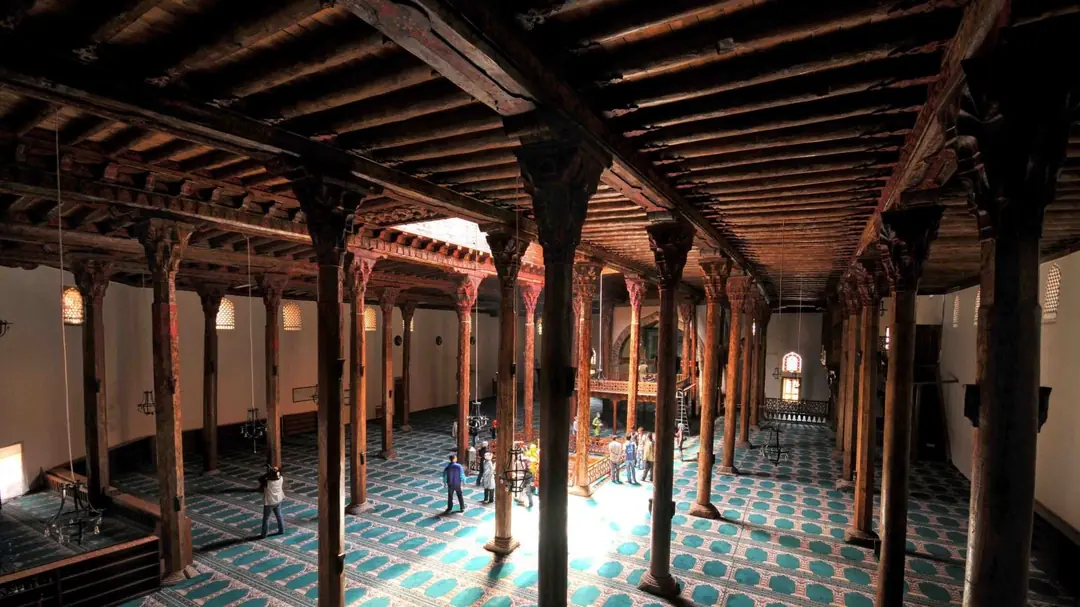
Walk into the Eşrefoğlu Mosque in Beyşehir and the first thing you meet is a forest. Forty-two wooden columns stand in rows, dark, upright, patient. A timber ceiling rests on them, and light comes down from above to settle on the carpet below.
Nothing in the room raises its voice. The craft is everywhere, and it asks for no attention. That is the first lesson of the place, and the hardest one to copy.
The mosque
Süleyman Bey, the second bey of the Eşrefid dynasty, commissioned the mosque about a hundred metres north of Lake Beyşehir. Work began in 1296 and finished in 1299. He died in 1302 and was buried beside it.
Forty-two cedar columns, each about 7.5 metres tall and 40 centimetres across, carry the roof. Local tradition says the trunks were soaked in the lake for six months before they were raised. Whether or not the story is exact, it shows how patiently the builders thought about wood.
In 2023 UNESCO inscribed the mosque as one of five Wooden Hypostyle Mosques of Medieval Anatolia, built between the late 13th and mid 14th centuries. Each stands in a different province. Each joins a stone shell to a wooden interior. Each was raised by people who trusted timber to last.
The pulpit
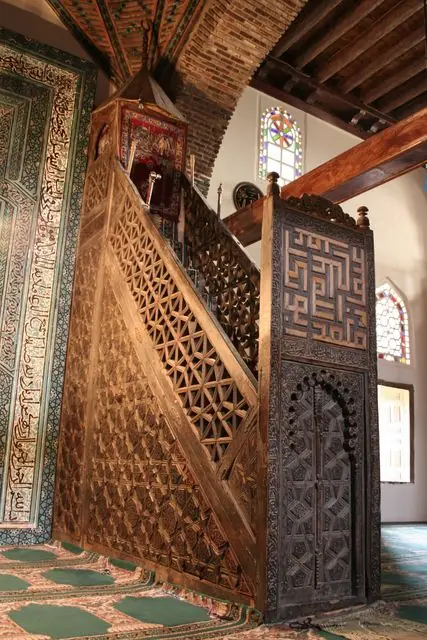
The minber is the quietest masterpiece in the room. It is carved entirely from walnut, and it holds together without adhesive and without metal fastenings.
The technique is called kündekari. Small carved pieces are cut to interlock, tongue into groove, until they read as one surface. Stars, lattices and geometric panels grow out of that logic. The ornament is the structure.
That is why it has lasted. Wood swells and shrinks with the seasons, and a joint made of wood moves with it. Metal rusts. Adhesive ages. A good fit does neither.
The walnut
I have stood inside that room. The walnut does not announce itself. It simply holds, the way it has held for seven centuries.
It is the same Anatolian walnut we work with in our Ankara workshop. Dense, slow grown, never the same twice. After thirty years at the bench, I read the grain as a record of the tree's seasons, something to be understood before it is cut.
Our pieces speak a different language from kündekari. We pair walnut with resin, and we say so plainly. The discipline, though, is the one the Beyşehir masters kept. Do not rush the wood. Do not hide it. Let it do what it has always known how to do, outlast the hands that shaped it.
What remains
Seven hundred years on, the pulpit is still doing its work. No one asks it to prove anything. It stands, it holds, and it is read by every hand and eye that passes. A craftsman could ask for no kinder verdict.
Sources